Thursday, 23 May 2013

“Speculations and Rejections,” Nancy M. Thompson and Maggie M. Williams

As the session organizers stated in the call for papers, Blunder was a session that could explore “any aspect of scholarship on the Middle Ages” with the goal of tracing “...some of the ways in which ‘blunder’ has served as an historical actant, ‘making things happen’ (for good or ill) that could not be anticipated in advance and which (somewhat and somehow) escapes full human control.” Nancy and I chose to consider the ways in which our scholarly rejections might be productive (or not). We decided to highlight some of our concerns with the standard practice of anonymous peer review through a short performance piece. We hoped (and were delighted to find) that our dramatization would open up a discussion on the positive and negative aspects of the peer review process in the humanities. If our blunders can serve to inspire a revision of current practices, then we may be able to make something happen after all.

This blog post provides the text of our handout and the script of our performance. Unfortunately, we do not have a video of the performance, but we included a few still photos to capture the mood. PLEASE comment on what you read and keep the conversation going!

HANDOUT:
What you will hear today is a dramatization. Except for the opening salutation, the text of this presentation is a collage of actual quotations from letters we--and our colleagues in other areas--have received in response to articles submitted to peer-reviewed publications in the field of art history. Often, the critiques that appear in those letters are unnecessarily cruel, not constructive or helpful, and motivated more by politics than true collegiality. For many specialized areas, there is also the problem of content versus method, in which reviewers are experts on a given topic but potentially prejudiced against an alternative approach to that material. In many cases, the anonymity of peer reviewing is virtually impossible given the small pool of experts in a given field. Today, we hope to draw attention to these issues by highlighting some of the withering critiques that have heretofore remained hidden away in the shameful dark corners of our file cabinets.

Here is a partial list of some blogs and websites that are bringing similar letters to light:


SCRIPT:

NANCY:

(types on a laptop)
 Aaaand, send!
(pushes back from computer, sighs)
Ooh, I can’t wait to see what my peers think of my work!


MAGGIE:
(haughtily reading over her glasses, marks a paper feverishly while groaning in disdain. She then puts the paper down on the desk and picks up another sheet of paper, from which she reads) 
 Dear Professor Thompson,

Thank you for submitting your essay “A Postcolonial/Feminist/Ecocritical/Vital Materialist/Phenomenological Reading of Some Medieval Works of Art” to the esteemed Journal of Medieval Studies. Although none of our reviewers are familiar with the “theories” that you have explored, many of them have spent decades immersing themselves in the minutiae of the period when the works were produced. They have weighed your paper, and, unfortunately, found it to be lacking.
As you are no doubt aware, letters like this one are often comprised of a basic template, with some specific criticisms interspersed. In order to expedite the process, we have compiled a synopsis of critical comments which we hope you will find helpful:
(Actual quotes begin here:
  • On the one hand, the basic premise of the essay is both interesting and worthy of exploration, and the author brings some useful insights. On the other hand, the article as a whole is rather unsatisfying. In addition to needing the usual careful editing for grammar and typos … I find the rhetoric an odd combination of hyperbole (at the beginning) and overreliance on secondary sources (throughout) used in unsophisticated ways....I find the references to/juxtapositions with modern thought here and there annoying, but that is perhaps more a reflection of my own stylistic predilections. More seriously, the introduction of the figure of Moses is poorly done, and besides, “Medieval Codex 312”  (a manuscript I know something about!) has the earliest horned Moses, not “Medieval Codex 313”, which undercuts some of the force of the essay’s rhetoric (and reliability). I may as well point out too that while perhaps Babel was associated with Nimrod as a giant, that is not what is in the picture as far as I can tell. Finally, the essay doesn’t really bring the conclusion home in any satisfying way. ....
  • I'm unconvinced…
  • The author's most original contributions are the speculations about the multiple meanings of [the objects]... These speculations, however, are not based on any contemporary literary sources and derive entirely from the author's imagination. I question whether this is a sufficient source for a published article.
  • I believe this sort of approach has little value. It would be far better if a chronological and comprehensive review of the medieval interpretation of [the objects] was attempted. A compilation of literary sources is necessary first.
  • So the argument is really a set of assertions, with 'might haves' and 'could haves' instead of evidence.
  • Violation [of the manuscript] begets a certain type of empathy?  But this should not be confused with scholarship.
  • The author needs to consider the possibility that visual similarities might reveal workshop links, (or, alternatively, common doctrinal/theological preoccupations) 
  • Professor Thompson needs to read the most important dissertation in this area, a recent work by.... Nancy M. Thompson.
  • the work lacks the necessary scholarly apparatus
  • the essay is methodologically unsophisticated
  • You seem to cherish a sentimental attachment to your object of study that is distracting at best and, taken at its worst, conveys a lack of the critical distance necessary for a serious academic study
  • the author comes across as overly earnest
  • Most problematic, however, is the author's assumption that all her readers are Christians -- or even all Protestants since she dumps on Catholics, too. This is deeply offensive to all her academic readers. ... Finally, the topic, although a woman writer [sic], does not cover issues of gender or women's place.
  • ...perhaps, but I remain unconvinced.

In conclusion, one of our editors would like to add that she is very sorry, not least because she’s devoted a tremendous amount of her own time and effort to get your paper to where it is, and she hopes this won't discourage you from submitting other work.
I’m sorry to say that we have decided not to publish the paper, although we did enjoy reading it. 
Sincerely,
The Editors

"Scribal Blunders, Poetic Wonders: Reports from a Modern-Day Scribe," David Hadbawnik


Three common types of mistakes in scribal practice—homoioteleuton (eyeskip of words, phrases, or lines); dittography (accidental repetition of words or letters); and haplography (the opposite of dittography: accidental omission caused by adjacent similar words or letters)—are familiar to those who study medieval manuscripts. Like textual instances of anamorphosis, these skips, stutters, and omissions fix us in place as readers, connecting us in a moment of pause with the all-too-human ghost that hovers behind the text. Carelessness, one imagines, bred of exhaustion, explains many of these scribal blunders. We picture the scribe, harried and hurried, toiling in a dim room at a desk surrounded by the tools of his trade: parchment, ink, books.

Then there are the “new” scribal errors wrought by technology.

Print, digital publication, and auto-correct have proven every bit as error-prone as the human hand, leading to embarrassing and amusing blunders in their own right. In the pictured example, we see an online community of medievalists, friends, and scholars engaging in a game of one-upmanship in punning on the humorous mistake produced by auto-correct. The more serious question this encounter raises is whether we have outsourced the ability to make such blunders at all—is the evocative error that connects us with the medieval scribe severed and sealed off behind the digital scan, the pdf, the touch-screen? (And, coming soon, of course, the thought-screen.)


My interest in scribal transmission is driven by my work as an editor and publisher—I simply want to see what happens when a text is copied out by hand rather than produced via print or digital technologies. Bruce Andrews—a leading member of the first generation of “Language writers” to emerge during the 1970s—calls for a means of overturning perceived hierarchies in language and poetry. “The key,” he writes, “to see how best to involve or implicate the Reader” (capital R). He characterizes this opening of the text as “a move toward participatory democracy—away from the Author’s sovereign authority,” with the goal of “empowering” the Reader. “But”—he asks—“what kind of Reader could be empowered? And what kind of textual experience is best equipped to deliver or make possible this Reader?” While attending to the nuances and complexities of rethinking scribal practice—the de-romanticizing of the hand as a technology undertaken by Jonathan Goldberg, the confused and confusing gendering of scribal vs. print transmission explored by Wendy Wall, and the concepts of chirographic presence [1] and scribal communities that Harold Love and Arthur Marotti attempt to explain—scribal practice, and its attendant errors, seems a productive place to look.

For this purpose, I chose an unpublished manuscript by the late poet kari edwards, the “Joan of Arc” project, housed in the poetry archive at University at Buffalo.


kari edwards [2], prolific and vocal as a transgender activist as well as a poet and artist, died of heart failure in 2006 at age 52. The Joan of Arc project—given the deliberately “unspeakable” title dôNrm’-lä-püsl—is described by edwards in a book proposal as “a reexamination of jehenne d’arc (la pucelle) … the story of la pucelle becomes only the framework for a language out of bounds, a narrative that is on the edge of consciousness.”

“Language on the edge” seemed a productive angle for the scribal project, especially given the added element of edwards’ difficult handwriting. Her book proposal includes a plea for funds to hire an editor, explaining that she is “severely dyslexic.” Written out in somewhat chaotic fashion in a numbered set of composition notebooks, the text provides a number of scribal challenges.

I set up a scriptorium at my table during the Buffalo Small Press Bookfair, an annual event that draws vendors and authors from around the country.


This fortuitously replicated at least the challenging atmosphere of a crowded, busy scriptorium. We know little about such spaces, but some 17th century witnesses describe “many scores of clerks” working to produce subscription newsletters (Love 125). As one can see from the images, volunteer scribes have limited workspace, and are surrounded by people talking and walking around them. They are both part of and removed from that public space: performative in the act of writing, but closed off in concentration. Scribes were given their choice of notebook pages to copy, as well as their method—they could attempt to render edwards’ text as accurately as possible, reproducing obvious misspellings, cross-outs, and arrangement, or they could edit and rearrange the text as they saw fit. Essentially, I wanted to give the scribes a choice between mimicking the amanuensis who first copied Beowulf, ignorant of Old English and accurate to a fault, or Grimur Jonsson Thorkelin, who knew just enough to make some emendations (Klaeber’s Beowulf xxvi).

With these pages in hand, I sought an opportunity to produce second- and third-generation copies of edwards’ text, to test the concept of chirographic presence and measure which mistakes might be carried over, and which corrected in the process. In the meantime, I discovered that some poet-acquaintances—Susana Gardner and Pattie McCarthy, of the dusie kollektiv and Dusie Press—had pursued a scribal project of their own.

     Susana Gardner:


      Pattie McCarthy:


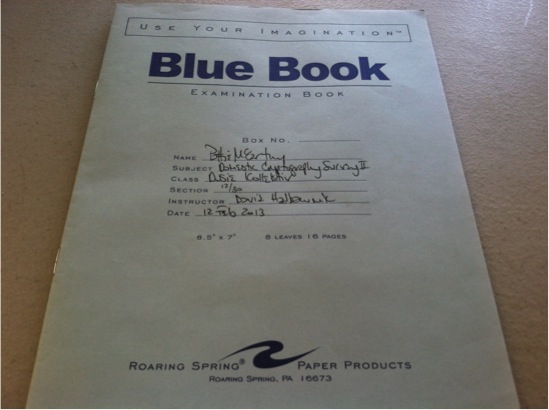
McCarthy engages in a hand-written process for reasons that dovetail with some of my own concerns regarding technology and community. “I wanted to handwrite those poems specifically in a sort of penitential way,” she reports, “like writing ‘I will not chew gum in class’ 100 times on the blackboard.” This calls to mind Goldberg’s characterization of handwriting as a “disciplinary submission,” a rote activity best rendered with as little variation as possible—one that also echoes strongly with the punitive tone of Chaucers Wordes Unto Adam—interestingly, in this case, a self-inflicted punishment. McCarthy adds that the poems were originally drafted as text messages to her husband and friends, as she sat in a waiting room while her son received occupational therapy for Asperger’s syndrome. Thus, “those poems are really fraught for me with questions about my son’s privacy … handwriting them made me think about every word I was putting out there.” Here, we might think of Love’s “scribal community,” with its dual functions of disseminating “privileged information” and “bonding groups of like-minded individuals” (177). The hand becomes a means of reversing the pull of technology—a retreat from the too-easy spreading of information, a return to restricted intimacy augmented by the difficulty of making out McCarthy’s script.


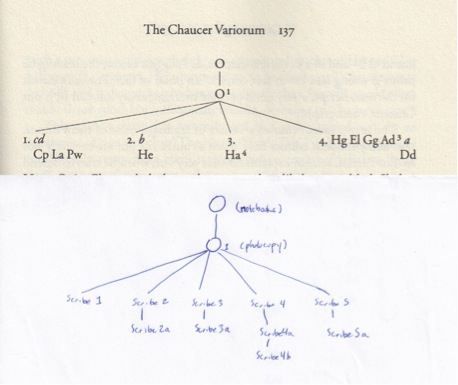
For the second scribal session, I chose the occasion of a friend’s end-of-semester backyard barbecue. Less chaotic, this atmosphere still offered a social setting in which scribes transitioned from a conversational circle to one of quiet concentration as they selected pages and copied them out. The aim was to produce a manuscript tree similar to the one mapped out by Ralph Hanna, based on Manly and Rickert’s scheme.

Ralph Hanna’s diagram of Manly-Rickert Chaucer manuscript scheme

He writes, “Here O is Chaucer’s holograph, a text that likely resembled Shakespearean ‘foul papers’; O1 is the archetype of all surviving copies” (137). In place of O1 , of course, is my photocopy of edwards’ original. Given enough time, scribes, and scribal branches, one could generate enough variations that a reader could work backwards, reverse-engineering the copies in an attempt to arrive at an original, authoritative text.


]

Results

The scribe is immediately confronted with a number of cruxes: edwards’ handwriting, uneven indents and margins, seeming neologisms, uncertainty over spelling and word choice, crossed-out words. Scribe 1 has attempted to remain faithful to page layout, yet chooses to interpret at several points, and finally reverses the order of text at the bottom of the page, perhaps from having run out of room.


Scribe 2 adheres even more closely to edwards’ text, maintaining even pen-stroke similarity, cross-outs, and a misspelling likely caused by dyslexia or haste.
Scribe 3 makes interpretive gestures, but also indicates uncertainty with question marks, deferring editorial decisions.

Up to now, what we might call the chirographic presence of the author’s hand, even in photocopy, has kept first-generation scribes from straying far from the original.


This second-generation scribe takes more liberties, employing the negative space of the page (perhaps suggested by edwards’ frequent use of ellipses), recasting cruxes as visual elements, poetically stretching the language and reconstituting words in ways that evoke edwards’ stated aim of making a “language out of bounds.” Moreover, for the first time, we must consider the materiality of the writing—here tiny, all-caps; and ink—a thicker felt tip or ballpoint—to the scribal process. The process resembles in miniature the transmission of John Donne’s poetry described by Moratti. It begins with the relative control of circulation among an “authorized coterie” (148), but moves outwards, away from authorial control (149), towards the “creative freedom that collectors and imitators in the system of manuscript transmission felt free to exercise” (153).

But the process is unpredictable. Scribe 3a feels free to reorganize Scribe 3’s line breaks, which followed edwards, into more syntactically logical units. Yet 3a retains 3’s uncertainty about some words, and creates a jaggedness on the left margin not found in the original.

Working from a different page of the text, Scribe 4 introduces an “eyeskip” type of error, missing a line midway down the page. Also, in an attempt to accurately render edwards’ own illegibility, the scribe creates interpretive difficulties that haunt future copies.

Neither 4a nor 4b, of course, can recover the missing line. By the time we reach the third generation, Scribe 4b, the look and language bears little resemblance to edwards’ text.


For the final page, Scribe 5 rearranges edwards’ slanted text, exacerbates some of the handwriting issues, and introduces new errors, shortening “message” to “mess” and inserting “hardboiled,” perhaps inspired by edwards’ writing of “bequeathed,” though that word is also copied.


Scribe 5a reproduces some of 5’s errors, but cleans up the presentation, and recovers “message” from “mess.”


Again, the neat cursive writing and letter-format introduced by Scribe 5a, while markedly different from the original, suggests a likely way that this page might be laid out for print.


Conclusions
When Chaucer admonishes Adam Scriven, he not only establishes a top-down relationship between “making” and “writing” that persists through English literary history, he also expresses an anxiety: that the error might lie with the original, might be written into the original in ways that no scribe can ever correct. Chaucer, himself a professional bureaucrat subject to punishment for slips of the pen, responsible for keeping records in his own hand (Carlson 11), worries that anyone can change something at any point in the line of transmission. Errors level the playing field between author and reader in productive ways, ways that Bruce Andrews and other avant-garde practitioners often call for. Copying a difficult text such as edwards’ joan of arc, the scribe is thrust into a collaborative environment, making decisions that would all have been elided in a print edition. While worrisome and opaque, errors—their inherent presence in an original, and multiplication by the scribe’s hand—tend toward a kind of fellowship, individuation, and freedom, which I look forward to further exploring.


For that, I need your help. Pattie McCarthy has agreed to provide a chapbook length set of poems for scribal copying later this summer, to be published by eth press, a venture under the umbrella of punctum books I’ve undertaken with co-editors Dan Remein and Chris Piuma. I envision enlisting a number of scribes, with the aim of producing 50-100 handwritten copies of the book.  If each scribe copies out three books, he or she can keep one—or trade it with another scribe—and provide two for the scribal publication run. Together, we can produce new errors—new poems—and find out what happens.


Works Cited
Andrews, Bruce. “Hearing Ends in Darkness” (course packet, University at Buffalo, Buffalo,
NY, Fall 2008).
Carlson, David. Chaucer’s Jobs. New York: Palgrave, 2004.
Gardner, Susana. Oceanids [dream pomes]. New York: Dusie Kollectiv, 2013.
Hanna, Ralph III. Pursuing History: Middle English Manuscripts and Their Texts. Stanford: Stanford U P, 1996.
kari edwards papers. dôNrm’-lä-püsl. Poetry Archive, University at Buffalo Library.
Klaeber’s Beowulf. Edited by R.D. Fulk, Robert E. Bjork, and John D. Niles. Buffalo: U of Toronto P, 2009.
Love, Harold. Scribal Publication in 17th Century England. New York: Clarendon, 1993.
Marotti, Arthur F. Manuscript, Print, and the English Renaissance Lyric. Ithaca: Cornell U P, 1995.
McCarthy, Pattie. Domestic Cryptography Survey II. New York: Dusie Kollectiv, 2013.


[1] “Chirographical transmission represents an intermediate stage between oral and typographical transmission in which the values of orality—and the fact of presence—are still strongly felt. The written word is therefore more likely than the printed word to promote a vocal or sub-vocal experience of the text, and a sense of validation through voice…Derrida rejects both this priority assumed for speech and the ‘reality’ of presence” (Love 142). “The notion of ‘presence,’ whether or not regarded as philosophically sustainable, provides us with a method of discriminating between modes of signification as being more or less distanced from a presumed source of self-validating meaning” (Love 144).

[2] Images of kari edwards' manuscript reproduced with permission of the edwards literary estate, as well as the Poetry Archive at University at Buffalo. Images of Pattie McCarthy and Susana Gardner's books reproduced with permission of the authors, respectively.

"Slices and Splices," Marian Bleeke and Anne Harris


In advance of this year’s International Congress on Medieval Studies, we (Marian Bleeke and Anne Harris) posted the following CFP on the Material Collective’s Facebook page:
Medievalists, ever want to cut your Kalamazoo paper up into little pieces? Let us do that for you - and turn it into something else. Poetry.
Anne Harris and I are going to be presenting found word poetry based on papers from the conference as "Slices and Splices" in the Blunder panel sponsored by the Babel Working Group on Saturday afternoon. And we need raw materials.
If you would like to see your work transformed, you can either send it one of us in advance (m.bleeke@csuohio.edu or aharris@depauw.edu) or give one of us your hard copy after you present.
We will keep our sources anonymous.
This was the result:

When it was still a word of body, blunder meant to stumble around blindly, to grope about, to lurch and sway numbly. It’s from the Old Norse blundra – “to shut one’s eyes.” It embodies the consequence of the loss of perception, of perspective –especially when the choice not to see is yours, especially when you close your eyes to the bigger picture. Blunder as self-sabotage, blunder as willing yourself to rail against the tempest (or some other enormous thing you can’t control) with your eyes closed. Now, it can be a word of mind, of language action, of event. Now, we can soften the idea with French, a faux pas, more elegant than a blunder, side stepping the issue. Now, right now, with cutting and seeking and groping blindly through words and purposefully shutting our eyes to the big picture in favor of the little words, we can think of blunder as the writer before the thing fumbling for words. Looking at image, text, object, idea and willing the words to come. They do as they please. This is a few minutes in the blunder of language, those few minutes pulled from hours of writing in which the words pull you along, sentences separate from paragraphs, and words jostle the coherence of the page away. This is the fantasy, built on the mistrust of language and the yearning for words of cutting and pasting. I think I love words more than I love language: five, dogma, crenelated, vignette, Coptic, ruminating, contact, gruesome, fostered, perpetrators… I could do this all day. And those aren’t even my words, and yet I love them. I take them from someone else’s paper and savor them. In our blundering, we asked blindly for papers we might cut up. Never mind about meaning, we can blunder through that later. What we asked for, really, was trust. Blunder takes trust. It leans on trust to blunder through the blindness, the misstep, the ridicule, and the realization. To get to the other side of blundering – to open your eyes to see the big picture again. Quick! Close them, back to blunder. Back to the few minutes of every paper in which we trust ourselves to play with a word, take it out of context and let it be, let it become. Is this the prosaic brushing up against the poetic?  We can blunder through that later. This is the fun of blunder, the blind man’s bluff, the lunging and the catching of a word, a phrase, a sentence. The delight in calling it poetry.


And so I have read and been taken by and wanted and took words and this is what happened:


I entreat the audience for help
In my quest for comparable imagery
[for] our much-heralded “return” to the object
objects par excellence
the phenomena that are at work
works [that] call attention to their own facture
unrolled and read aloud
they “speak” of their own significance
girding [their] rhetorical force
by the disruptive presence of that which is supposed to be absent.
Artists turned pigment into glass medieval efflorescence
copying, replication, and remediation
For his tomb announced that he was dead, dead, dead, except that he was still alive!
dozens of copycat tales,
mimetic performativity
Alice thus taunts images
[seeking] some measure of understanding
in this tangle of concerns
just adjacent to the missing segment.


Rupture!
Rather abruptly
the Raising of Lazarus could almost be happening.
Fantastically imagined on a vivid blue ground
built solely on style.

Instead of imagining
the world outside of the window itself.
The web of leading is cut to compose
a break in the path
to the border and to the stars

Illumination was active,
you see here and here.  
Until the swath of green 
glowing and deeply colored
stops the illusion.

To populate the lights
a foreigner, a Frenchman, threw a rock.
And dramatically shifted the opaque decoration,
the darkest creases that dark light so desired,
and the especially problematic painted indications
of shining colors now-destroyed.
Something Native
The deposed king inhabited the island
and fabricated memorializing self-identifications;
time consuming indigenous traditions,
reticulated headdresses with elaborate ornamentation,
adroitly dynamic sword handling,
and the active veneration of horizontal continuity

Our lengthy and intimate allegiance to
this thriving concern deliberately kept us
assimilated and assumed a sense of the singular
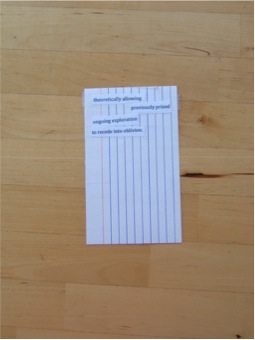
theoretically allowing our previously prized
ongoing explorations 
to receded into oblivion.


Surviving Ensembles
Surviving ensembles 
That descended from above
Promoted brief but spectacular
Astronomical associations

The Golden Wood commanded
Create
Continuity
Long – standing
Further,
More


Fierce Prejudice
Illumination is delicate
Like giants towering beside their tower
All scraggly-haired and bulbous-nosed
Ruminating on interconnections that are
Most curious
And utterly spurious

Our lingering fears are rendered again and again like
Apocalyptic hordes only purportedly imprisoned

How estranged we are – yet
Are all interrelated
In harboring a love that was
Already lost at the time


Purposes of Procreation
I had analytical approaches
Sumptuous objects
Pairs of peacocks and leonine quadrupeds
And some real work to do

Now, turned inside out, and, indeed, halved
I have penned a monograph
Turned pigment into glass
And now rival creation itself in my 
Mimetic performativity

It is a luxurious document
Girding its rhetorical force with indigo sections
Full-fulio swaths of small gold dots
And a sumptuous silken pastdown
Beautifully bejeweled beneath the golden script

Even its more mundane-looking representational strategies
Are painted to look like precious Byzantine silk
It is a site of replication and re-presentation
A reflection of its partner
And a copy without an origin

The Effort of Cutting
The thing after the cutting
Wants to stand and hold fast
Simultaneously bearing witness
To its easily destroyed manufacture

Trees and stones
Are always forever moving towards
Illusions of the analogous, an invented humanity
As statue oscillates after stone

The dice tumbling
Escalate quickly upwards as an immortal god
Obsolete in language if not in practice
Of prayer and poem in their pristine state

What had been whole, an impossible object
Is now molten and messy, everywhere and inexplicable
A reliable source of ignition, of volatile shattering that
Simultaneously explodes and disintegrates into powder

A knife cutting
Forever cut off
As human presence
What a lovely, creepy idea


Failblog/Fumblr, Asa Simon Mittman and Shyama Rajendran

I fell into a weird syntactical trap and just couldn’t get out. Thank goodness that it’s in print forever. I blame scholasticism. 
–from Karl Steel’s post, “Killing is OK. Or not. Or both. Or neither.”
Sometimes ideas don’t work. Failure is an inevitable fact of life, and we have all experienced it—that moment where students look completely confused, that paper with a logical hole the size of the (former) Soviet Union, that presentation that just did not fly. In the humanities, however, we do not often discuss our failures. So how can we understand the utility of being wrong? In the sciences, when an experiment fails, the results are often published so that the community can benefit from the errors. 
Let me assure you that I very much know that WISCONSIN IS NOT MICHIGAN.
–from Jonathan Hsy’s post, “Wisconsin is not Michigan (Where's Troy?)
In the humanities, we’re not often demonstrably “wrong,” since much of what we offer is interpretive. You might disagree with Asa’s reading of the Wonders of the East, but would be hard-pressed to conclusively invalidate it. Still, many of us are still in a 19th-century paradigm of the lonely scholar, toiling in solitude, with a glass of absinthe at the elbow, so our failures are solitary. When I head down a wrong-headed path, I (hopefully) learn something. But you don’t.
I have since seen all three manuscripts, and it turns out that I was not only flatly wrong, but that the actual situation is much weirder … The error is there, in perpetuity, when the bizarre truth is much more interesting.

This is why we started “Fumblr: The Academic Failblog” a place for any of us to post our scholarly missteps for all and sundry to read and learn (and laugh) from. 

In the long run, as I worked through the many consequences of my ‘failure to understand,’ I followed more investigations, worked through anxiety, thought deeply and—at last—reached an acceptance of the fact that I investigate a historical period that will always offer up such instances of profound discomfort.  To wish it were otherwise would be to wish away that aspect of the problem that continues to inspire me, as much as it remains a challenge.
–from Emily Gephart’s post, “The Failures of Symbolism
We no longer aspire to be solitary figures, toiling in isolation. We want to embrace collaboration, to facilitate community through the work that we produce. This shift is in part attributable to the ways in which scholars have embraced social media—we blog, Tweet, and have lively Facebook conversations. However, the veneer of optimism that we bear about the community created by these spaces masks a truth that we do not often acknowledge publicly: what we do is hard. We make mistakes when we teach, we constantly revise what we write, and we frequently falter, and then learn, and keep going. The brilliant conference papers and amazing publications are not achieved with ease, and we must remember the battles as much as we cheer the victories, and might stop for a minute to mourn each other’s losses.

We bandied about a few titles:
[Grandiloquent]:“Before the Phoenix Rises: Swimming in the Ashes of the Humanities.”
[Goofy]: “Faceplanting: Tripping Over the Scholarly Cracks.”
[Self-Abusing]: “Head, Meet Desk”
[Colloquial]:  “Scholarly Facepalms.”
And our final [for now] decision:  “Fumblr.”
All are probably wrong, but perhaps one or more is productively so.

“Fumblr” is an attempt to create a space where these failures and struggles can be shared. The idea for the blog was, aptly, germinated in a fumble—a throwaway joke in response to the question of how one encourages undergraduate students to take risks when they are afraid to fail. We might attribute our hesitance to wear our failures as openly as our successes to the fact that our products are valued highly in the university, while our processes are invisible ghosts. However, it is the dynamic, transformative nature of process that allows us to reach what we consider a product. Further, the silence surrounding the conversation about the processes inherent in scholarship and in learning to teach does a disservice to graduate students and early career scholars, prioritizing product over discovery. If we are serious about experimental approaches and risk taking, we have to be prepared to fail, at least on occasion. 
The whole conference, while fantastic, was filled with these little failures. Fortunately, there were some truly wonderful people whose kindnesses helped prevent these failures from ruining my experience.
–from an anonymous post about “Literally falling down a flight of stairs

We are transformed not only by our successes but by our difficulties, and by the responses of our friends and colleagues to them. “Fumblr” is designed to encourage a collaborative space, with contributors (rather than authors) who share their stories, with posts related to research, teaching, writing, job searches, and so on. Further, we hope to foster a sense of community in which we can struggle together just as easily as we succeed together.

Join us in faltering, in tripping over the cracks in our own arguments, in falling down the solipsistic rabbit holes of our personal-professional preoccupations. Fumble with us, so we can all take a step forward, together.

Wednesday, 15 May 2013

Reading List

When someone asked me, after [Asa and Shyama's] presentation at the Babel session at the Zoo, what I was going to submit to the blog, my first response was to blush deeply, for there are many and many screw-ups I might own up to and I am not entirely sure I want them out there in the blogosphere, given some painful recent experiences that have made me more than ordinarily self-doubting. However, this one is a classic, and since I repeat it on a regular basis, I feel it is my signature fumble; admitting to not having read something everyone else has read (or claims to have read).
So, it’s 1994 or thereabouts. I am in graduate school. I live in a bungalow with two other grad students, one in history, one a fellow art historian. We throw awe-inspiring parties where Comp Lit grad students end up overcoming their disciplinary aversions and sleeping with Political Science grad students, and the shrubbery is full of underpants, wine bottles, and other such items in the morning. It is my housemates’ fabulousness (and trust funds) that make this all possible. I view these parties as a form of penitential suffering; I really hate it when other people use my bedroom for their dangerous liaisons.
Also, some of the other grad students are Horrible People. I am standing in the garden, holding a beer and having one of those screamed conversations you have at loud parties. The funny, handsome, and arrogant N says, “I hate it when people in grad seminar pretend to have read something they obviously haven’t read.” I nod and agree.  He says, “I make it a policy just to announce that I haven’t read it. If they have a problem with that, they’re posers and snobs.” I nod and agree some more, and then I shout, “Exactly. I think we should all go around and admit what we haven’t read, and just get it over with.” G, who is in Rhetoric, raises her beer, as if this is a toast, and announces, “I haven’t read Of Grammatology.” This sounds radical and daring – remember that G is in Rhetoric and it’s the early nineties at Berkeley. N the good looking and already-published in Representations says, “I haven’t read anything by Norman Mailer.” Well, I have and I am tempted to flaunt it by saying, “Don’t bother.” Instead, fool that I am, I chime in, “I haven’t read Kant.” 
The conversation stops. The entire party stops. Silence absorbs my confession.
N, smiling, looks at me pityingly. “I wouldn’t announce that, if I were you.”
G, miming utter shock, not smiling. “But you’re an art historian, right?”
I always make my students read (some) of Critique of Judgment now in my MFA proseminar, thus inoculating them against this particular form of the fumble, but it’s inevitable. As Hugh of St.-Victor observed, “There are those who wish to read everything. Do not try to do this. Let it alone. The number of books is infinite, and you cannot follow  infinity.”
Alexa Sand, Utah State University

Sunday, 6 January 2013

Literally falling down a flight of stairs


A grad student fumbles right down a flight of stairs:

I was really excited about having been accepted as a participant in the graduate workshop that preceded the International Society of Anglo-Saxonists conference in Madison, Wisconsin. However, a few weeks before the conference I tripped going down a flight of stairs, and as a result I dislocated my ankle, fractured my fibula, and tore one of the ligaments. A week before the workshop began, I had surgery to install a plate on my fibula and repair the rest of the damage. My surgeon said that I would be fine to go to the workshop, which I didn't want to miss as we were going to be creating our own reproductions of pages from manuscripts (I had chosen a page from an illustrated Prudentius manuscript).

For most of the week in between the surgery and the workshop I was knocked out on some pretty heavy duty painkillers, but the day before I left I switched over to extra strength Tylenol, because there would be no point in going if I was loopy and half asleep for the entire conference. I took a practice drive around Fargo, as I would be driving solo from my parents' house to Madison, and went out to see the new Harry Potter movie to make sure that I could sit upright for a couple hours without being in a recliner or my bed. This was the first time in weeks that I had left the house for anything but doctor visits. The outing was a success, and so I breathed a little easier as I prepared for the car trip.

The next day I drove nearly non-stop to Madison, with only one gas stop along the way. When I arrived, I was invited out for dinner with some of the other workshop participants, at which point I realized that I had neglected to think about one fact: that the conference was entirely a pedestrian affair in the late summer heat, and I had not walked more than the distance to a car in several weeks. Fortunately, dinner that first night was only a couple blocks away, but I was already exhausted by the time I got there. This manifested in forgetting basic facts, like the name of the senior scholar I had been on a panel with at Kalamazoo a few months prior, and I only managed to figure it out after about ten minutes of racking my brain, by which point the conversation had entirely escaped from me. The whole conference, while fantastic, was filled with these little failures. Fortunately, there were some truly wonderful people whose kindnesses helped prevent these failures from ruining my experience of the conference. At the very least, I was saved from any greater embarrassments, like someone walking in on me as I attempted to get dressed after a shower in the communal bathroom in the middle of the night.

While dozens of people present at the conference will be able to identify this fumblr, it is anonymous to prevent the accidental discovery by job search committees in the near future...